
Dental & Skin Clinic, Royal Tunbridge Wells
Teeth Whitening in Tunbridge Wells — Look Like You've Had a Good Week
Professional whitening, prescribed and supervised by a registered dentist, with a realistic conversation first about how light your teeth will actually go.
- Prescribed by Dr Simon Azimi, GDC 81382
- Legal, regulated whitening — carried out by a registered dentist
- Custom-made trays, not a one-size mouthpiece
- Opposite Tunbridge Wells station
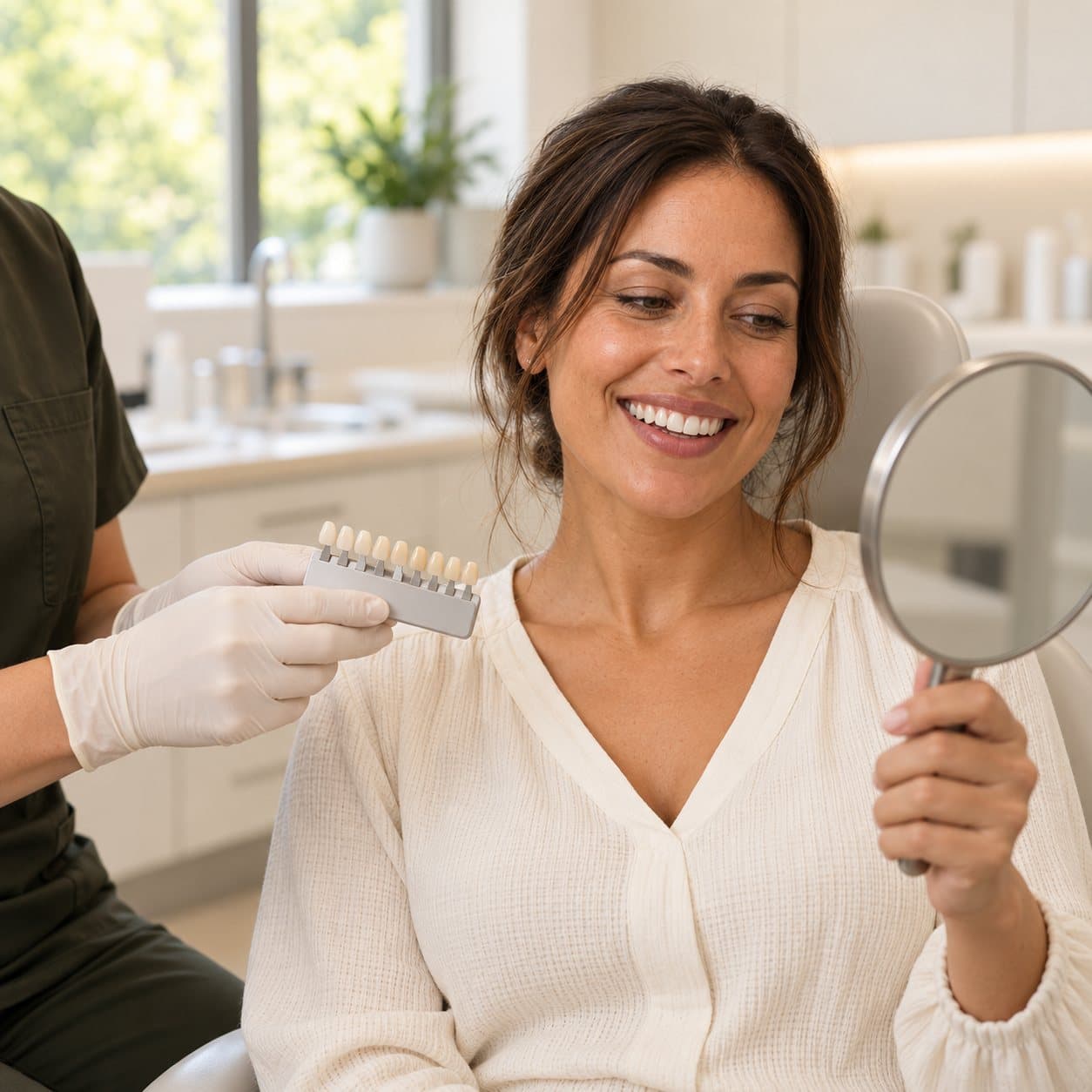
It happened slowly, which is why you can't point to when
Your teeth didn't yellow overnight. Twenty years of tea, morning coffee, the odd glass of red, and enamel that thins a little with age so more of the darker layer underneath shows through. Nobody has ever said anything. You still noticed.
Usually it's a photograph that does it. You look at one from ten years ago, then one from last month, and it isn't your hair or the lighting.
So you've had a look at what's out there. Charcoal powder that people online swear by. A £15 kit that arrived in a jiffy bag. An offer from a salon that seemed too cheap to be real. And somewhere in the back of your mind, a worry that half of it might damage your teeth — which is the thing you actually care about, more than the shade.
That worry is well placed. There's a lot of nonsense in this category, and some of it is genuinely unsafe.
What people actually notice
Not "wow, your teeth." Something vaguer, and better.
People ask if you've been away. They say you look well, or rested. Whitening lifts the whole face slightly, in the same way a decent night's sleep does, and because it's your own teeth in your own mouth there's nothing to spot.
In photographs it's more obvious, which is usually why people do it. You stop scanning the picture for your teeth. You stop picking the shot where your mouth is closed.
And the effect is not permanent, which is worth saying up front. Whitening fades. It's topped up rather than finished. But the trays are yours to keep, and topping up is a night or two rather than starting again.
Why patients across Tunbridge Wells choose us for whitening
It's carried out legally, by a registered dentist.
Tooth whitening is dentistry, and in the UK it can only lawfully be carried out by a registered dental professional. Dr Simon Azimi is registered with the General Dental Council under number 81382. That is a genuine difference from a beauty salon offer, not a marketing line.
Your teeth are examined first.
Whitening a tooth with untreated decay, a cracked filling or gum disease is uncomfortable and, in some cases, harmful. Every whitening case starts with an examination, and problems get sorted before any gel goes near your teeth.
Custom-made trays that fit your teeth.
Home whitening trays are made from impressions or a scan of your own mouth, so the gel stays on the teeth and off the gums. That's the main reason professional home whitening is both more effective and more comfortable than a generic mouthpiece.
An honest answer about the shade you'll get.
Teeth vary. Some lift several shades, some are stubborn, and some kinds of discolouration barely respond at all. You'll be told which category you're likely to be in before you pay, rather than afterwards.
Sensitivity taken seriously.
Sensitivity is the most common side effect of whitening and it's managed rather than dismissed — by adjusting concentration, wear time and by using desensitising products where needed.
Two minutes from the station, at the entrance to Calverley Park.
Whitening appointments are short, so it's an easy one to fit in around work or on the way home.
Book your whitening consultation
No pressure and no obligation — just a straight conversation about what whitening can and can't do for your teeth.
What is professional teeth whitening?
Professional teeth whitening is a dental treatment that lightens the natural colour of your teeth using a peroxide-based gel, prescribed and supervised by a registered dentist.
The gel breaks down the pigment molecules that have built up inside the tooth over years of eating, drinking and smoking, so the tooth appears lighter.
It changes the colour of natural tooth structure. It does not remove or damage enamel, and nothing is drilled or filed.
What kinds of whitening are available?
In-practice whitening. A stronger gel is applied in a single appointment with your gums protected, sometimes activated with a light. It takes around an hour and gives a more immediate change. It's often combined with home trays afterwards to reach and hold the final shade.
Which suits you depends on your teeth, your sensitivity, and how quickly you need the result. Home trays give more control; in-practice gives more speed.
Does teeth whitening damage enamel?
Professionally prescribed whitening at regulated concentrations is not considered to damage enamel. The gel works by breaking down stain molecules within the tooth rather than by removing tooth surface.
What can cause harm is misuse: excessive concentrations, badly fitting trays that leak gel onto the gums, whitening over untreated decay or exposed roots, or repeatedly whitening far more often than advised. All of those are reasons the treatment is supervised rather than sold over a counter.
Abrasive whitening products are a separate concern. Charcoal pastes and heavily abrasive "whitening" powders can wear enamel over time, and because the layer beneath enamel is yellower, wearing enamel away can eventually make teeth look darker rather than lighter.
Is teeth whitening painful?
Whitening itself isn't a painful procedure — there's no drilling and no injection. The common side effect is temporary sensitivity: short, sharp twinges, usually to cold, either during the course or for a day or two after it.
It affects a significant proportion of people to some degree, it's usually mild, and it settles once treatment finishes. If it's troubling you, tell us — the concentration can be reduced, wear time shortened, or a desensitising gel used alongside. Sensitivity is not a reason to stop wanting whitening, but it is a reason to have it supervised.
Persistent or severe pain during whitening is not normal and should be checked.
Is it illegal for a beautician to whiten teeth in the UK?
Yes. In the United Kingdom, tooth whitening is legally the practice of dentistry, and it can only be carried out by a dentist, or by a dental hygienist or dental therapist working to a dentist's prescription. Anyone who is not registered with the General Dental Council and who carries out tooth whitening is committing a criminal offence — and the GDC has prosecuted beauticians and salons for exactly this.
This matters for two reasons, and the second is the one that affects you.
The products are restricted, and for good reason. Whitening products containing or releasing more than 0.1% and up to 6% hydrogen peroxide may only be supplied to dental practitioners. The first use in each course must be carried out by a dental practitioner, or under their direct supervision, after which you can continue at home. Products sold directly to the public are limited to 0.1% hydrogen peroxide — which is a small fraction of the strength, and why so many shop-bought kits do very little.
Nobody has looked in your mouth. The regulation exists because whitening the wrong mouth causes damage. A dentist checks for decay, cracked or leaking fillings, gum disease and exposed root surfaces before treatment, because gel reaching any of those causes real pain and, in some cases, lasting harm. A salon is not qualified to make that assessment and is not legally permitted to try.
Whitening should also not be carried out on anyone under 18 unless it's to treat or prevent disease.
If you've bought a kit online or been offered whitening somewhere that isn't a dental practice, bring it in and ask. You'll get a straight answer about whether it's safe to use, at no cost and without judgment.
Why won't shop-bought whitening kits work?
Mostly because they legally cannot contain enough active ingredient to make much difference. A product sold directly to the public in the UK is limited to 0.1% hydrogen peroxide. A dentist can prescribe up to 6%. That is a substantial gap, and it's the main reason people report spending money on kits and seeing very little.
The other differences:
- Fit. A one-size mouthpiece lets gel onto the gums, where it causes irritation, and off the teeth, where it's doing nothing.
- No examination. Nobody has checked for the decay, cracks or gum recession that turn whitening from uncomfortable into painful.
- Unregulated imports. Kits bought from overseas sellers sometimes contain concentrations that are illegal to sell here, with no oversight of what's actually in the tube.
- Abrasives instead of whitening. Charcoal and "polishing" products scrub the surface rather than lightening the tooth, and can wear enamel with repeated use.
- No plan for sensitivity. When it starts, there's nobody to adjust anything.
What won't teeth whitening work on?
Whitening only changes natural tooth structure. It has no effect on dental materials, and that catches people out.
It will not lighten:
- Crowns — porcelain and ceramic do not change colour
- Veneers — porcelain or composite, both stay as they are
- White fillings — composite does not lighten
- Bridges — the same materials, the same result
If you have visible crowns, veneers or fillings in your smile, whitening your natural teeth will make those restorations look darker by comparison, because they'll stay where they were while everything around them lightens. That doesn't rule out whitening — but it may mean planning to replace or re-match those restorations afterwards, which is a cost worth knowing about before you start rather than after.
It also works less well on:
- A single dark tooth after root canal treatment — the discolouration is inside the tooth, and this usually needs internal whitening, a veneer or a crown instead
- Grey or banded staining from tetracycline antibiotics taken in childhood — sometimes it lightens a little, often it doesn't respond well, and veneers may be the more realistic route
- White spots and patches — these can become more or less noticeable after whitening, and are not always improved by it
- Staining caused by decay — that needs treating, not whitening
This is exactly the kind of thing assessed at the consultation, so you know what to expect from your teeth rather than from teeth in general.
Should I have a hygiene appointment first?
Usually, yes, and it's often the single most cost-effective step. A hygiene appointment removes the surface staining and hardened deposits that build up from tea, coffee, red wine and tobacco. That staining sits on the tooth rather than in it, so whitening gel doesn't lift it — cleaning does.
Two things follow from that. First, some people find that a clean alone gets them most of the way to what they wanted. Second, whitening a tooth that still has surface deposits on it gives a patchy, unpredictable result, because the gel can't reach the enamel evenly.
Whitening also requires healthy gums. If your gums bleed when you brush, that's treated first.
Step by step
What happens, from first call to finished shade
Any groundwork first
Hygiene treatment, and any fillings or gum treatment needed. Whitening does not go ahead over untreated problems.
Fitting and instructions
The trays are checked for fit, you're shown exactly how much gel to use — more is not better, and excess gel on the gums is what causes irritation — and you're told how long to wear them and for how many days.
Review
You come back so the result can be checked against the starting shade and any sensitivity discussed. If more is wanted and it's safe to continue, that's decided here.
Fees
How much does teeth whitening cost in Tunbridge Wells?
Professional whitening costs more than a kit from a shop, and it's worth being clear about what the difference buys: a dental examination, a legal concentration of active ingredient, trays made to your teeth, and someone to adjust things if you become sensitive.
If you have crowns, veneers or visible white fillings, factor in that they may need replacing afterwards to match your new shade. That's frequently the larger cost, and you should know about it before you decide.
Prefer to talk? Call 01892 547286
Professional whitening vs shop-bought kits vs salon whitening
| Professional dental whitening | Shop-bought or online kit | Beauty salon whitening | |
|---|---|---|---|
| Legal in the UK | Yes | Kits themselves are legal at up to 0.1% hydrogen peroxide | No — a criminal offence unless carried out by a GDC-registered professional |
| Maximum strength | Up to 6% hydrogen peroxide, dentist-prescribed | 0.1% hydrogen peroxide | Not lawfully permitted to provide the treatment at all |
| Examination first | Yes | No | No |
| Trays | Custom-made to your teeth | Generic mouthpiece or strips | Varies |
| Sensitivity managed | Yes — concentration and timing adjusted | No | No |
| Redress if something goes wrong | GDC-registered clinician, complaints procedure, indemnity | Limited | Limited |
| Typical result | Noticeable shade change | Little to none | Unpredictable |
Home whitening trays or in-practice whitening — which is better?
Neither is universally better; they suit different situations. Home trays are gradual, give you control over how far you go, tend to produce less sensitivity because the concentration is lower, and leave you with reusable trays. In-practice whitening is faster and takes a single appointment, which suits a fixed deadline.
Many people end up combining them: an in-practice session to make the initial change, then home trays to fine-tune and maintain it.
Whitening or veneers?
Whitening is the first thing to try if your teeth are a healthy shape and simply darker than you'd like. It's far less expensive, removes no tooth, and can be repeated.
Veneers are the answer when the discolouration is inside the tooth and won't respond — deep tetracycline staining, a dark root-treated tooth — or when the shape needs changing as well as the colour. Try the reversible option first.
Questions
Frequently asked questions
How long does teeth whitening last?
Typically somewhere between six months and a couple of years before a top-up is wanted, though it varies a lot. Tea, coffee, red wine and smoking bring the fade on faster. Because you keep your trays, topping up is usually a night or two rather than a full course.
Is teeth whitening safe?
Carried out by a registered dental professional at regulated concentrations, whitening is considered a safe treatment and has been used for decades. The risks come from unsupervised use — untreated decay, ill-fitting trays, unregulated imported products, or whitening far more often than advised.
Is it illegal for a beautician to whiten teeth?
Yes. Tooth whitening is the practice of dentistry in the UK, and carrying it out without GDC registration is a criminal offence. Dental hygienists and therapists can provide it to a dentist's prescription. A beauty salon cannot lawfully provide it at all.
How many shades whiter will my teeth go?
It depends on your starting shade and the cause of the discolouration, so an honest answer isn't possible until your teeth have been looked at. Yellowing from age, food and drink usually responds well. Grey tones and tetracycline staining respond less predictably. Your starting shade is recorded so the change can actually be measured rather than guessed at.
Will whitening make my crowns and veneers whiter too?
No. Crowns, veneers, bridges and white fillings do not change colour. If they're visible when you smile, whitening your natural teeth will make them look darker by comparison, and matching them afterwards means replacing them. Worth planning for before you start.
Does whitening cause sensitivity?
It's the most common side effect. Usually it's mild, short-lived, and settles within a day or two of finishing. It can be managed by lowering the concentration, shortening the wear time, or using a desensitising product alongside. Tell us if it's bothering you rather than pushing through.
Can I whiten my teeth if I have sensitive teeth already?
Often yes, with adjustments. Existing sensitivity has a cause worth identifying first — receding gums, exposed roots, worn enamel or cracks — because some of those need treating rather than whitening over.
What can't I eat or drink after whitening?
For the first 24 to 48 hours after each application, avoid strongly coloured food and drink — coffee, tea, red wine, cola, curry, tomato sauce, beetroot and berries — and avoid smoking. Teeth take up stain more readily immediately after whitening. A useful rule: if it would stain a white shirt, leave it for a couple of days.
Can I whiten my teeth while pregnant or breastfeeding?
Whitening is generally postponed during pregnancy and breastfeeding. It isn't an urgent treatment and there's no reason to take an unnecessary risk. Tell us if this applies to you.
Can under-18s have teeth whitening?
Whitening should not be carried out on under-18s except where it's for treating or preventing disease. Cosmetic whitening for teenagers is not offered.
Do whitening toothpastes work?
They can help remove surface staining, which makes teeth look a little brighter, but they do not change the natural colour of the tooth — they don't contain enough active ingredient to. They're a reasonable way to maintain a result, not a way to achieve one. Avoid heavily abrasive ones and charcoal products.
How soon before a wedding should I whiten?
Allow at least a few weeks. The shade continues to settle for a week or two after treatment finishes, and if any bonding, veneers or fillings need matching to the new shade, that work has to happen afterwards rather than before.
Can I whiten my teeth if I have fillings in my front teeth?
Yes, but the fillings won't lighten. Depending on how visible they are, you may want them replaced afterwards to match. This is assessed and priced up at the consultation so there are no surprises.
Getting here
Teeth whitening for patients across Tunbridge Wells and West Kent
Whitening involves short appointments — an examination, a scan or impression, and a fitting — which makes it an easy treatment to travel for.
We whiten teeth for patients from Pembury, a few minutes out on the A264, from Frant and Groombridge to the south, and from Tonbridge and Southborough to the north. The practice sits at the entrance to Calverley Park, directly opposite Tunbridge Wells railway station, with town centre parking close by.
Once your trays are made, the rest happens at home — so most people only travel in two or three times.
Find out what whitening would actually do for your teeth
The consultation answers the question the kits can't: how light will *your* teeth go, and is whitening the right treatment for the kind of staining you have. You'll get a straight answer, a recorded starting shade, and a price before you commit to anything.
Or call us on 01892 547286 — happy to answer questions over the phone first.
Mon–Fri 8:30am–5:15pm · Sat 10am–4:30pm1 The Lodge, Mount Pleasant Avenue, Royal Tunbridge Wells, Kent TN1 1QY
Reviewed by Dr Simon Azimi, GDC 81382